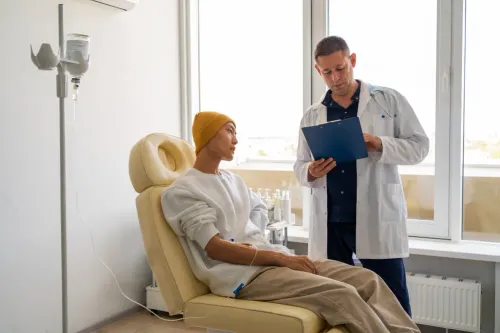

A second opinion can reveal whether immunotherapy fits your cancer, stage, biomarkers, previous treatment and health risks—or whether another treatment offers a better balance of benefit and harm. By the end, you will know which records to collect, which type of review to request, what questions to ask and how to assess local follow-up before treatment begins.
Key takeaways
- Carry pathology slides, reports, scans, biomarker results and a complete treatment timeline.
- Confirm the cancer stage, biomarker status and treatment goal before choosing immunotherapy.
- Ask which immune-related side effects require same-day medical attention.
- Leave with a written plan covering treatment choice, monitoring, alternatives and follow-up.
What a second-opinion oncologist reviews before recommending immunotherapy
Before recommending treatment, the oncologist reassesses the diagnosis, cancer type and stage, pathology, immunohistochemistry, scans, molecular and biomarker reports, previous treatment, symptoms, other illnesses, medicines and your treatment goal. Bring the complete records, not only a written summary.
Immunotherapy is an umbrella term covering checkpoint inhibitors, monoclonal antibodies, cancer vaccines and cellular therapies such as CAR-T. The clinician must name the exact drug class and regimen because eligibility, monitoring and risks differ.
| Review type | What the oncologist checks | When it applies |
|---|---|---|
| Pathology second opinion | Diagnosis using the pathology report, paraffin block or unstained slides, including immunohistochemistry | The tumour type or marker result is uncertain |
| Radiology review | CT, MRI or PET-CT images and reports, with a fresh interpretation of stage or treatment response | The scan findings or spread are disputed |
| Treatment-plan second opinion | The proposed regimen, treatment line, alternatives, expected benefit and risks | You want to compare recommendations |
| Full oncology consultation | All records plus examination, risk assessment and practical planning | You need an independent treatment decision |
This distinction prevents you from booking a repeat consultation when the real uncertainty lies in the biopsy or scan interpretation. Ask which review you need before scheduling an immunotherapy second opinion in Dombivli, and whether the clinician will examine the original material rather than rely on copied conclusions.
Records to carry and tests that determine whether immunotherapy fits
Bring the complete record, not only the latest prescription. If you are seeking a second opinion oncologist immunotherapy in Dombivli, use this checklist:
- Biopsy or surgical pathology report, immunohistochemistry report, and pathology slides or paraffin blocks.
- PET-CT, CT or MRI reports, plus image discs or secure links.
- Complete blood-test results, including recent blood counts and organ-function tests.
- Genetic, molecular and biomarker reports.
- Operative notes, discharge papers, and prior-treatment summaries with dates, medicine names and doses.
- Your current medication list, including steroids and supplements.
- A timeline of symptoms, diagnoses, treatments, responses, progression and significant side effects.
The oncologist matches the cancer type, stage and treatment line with evidence for the proposed medicine. Depending on the cancer, review may include PD-L1, mismatch-repair or MMR status, microsatellite instability, tumour mutational burden, HER2 and actionable driver alterations.
PD-L1 is not a universal pass-or-fail result. Interpretation depends on the assay, antibody clone, tumour type, scoring method and cutoff; the report may state a tumour-proportion score or combined-positive score. Ask which threshold supports the recommendation. A supportive biomarker does not guarantee benefit, and a negative result does not always exclude treatment.
Number the questions you still have and ask for the proposed drug, evidence, baseline tests and response-monitoring plan in writing.
How the oncologist compares immunotherapy with the other treatment choices
Immunotherapy is the best option only when its expected benefit exceeds the alternatives for your cancer, stage and treatment goal. Ask the oncologist to name the medicine and class, such as pembrolizumab or nivolumab as checkpoint inhibitors, and explain why it fits your tumour.
| Option | Potential advantage | Trade-off or fit |
|---|---|---|
| Single-agent checkpoint inhibitor | Less chemotherapy-related toxicity | Fits selected biomarker-positive or advanced cancers; benefit is not guaranteed |
| Immunotherapy plus chemotherapy | Can improve outcomes in selected cancers | More visits, blood tests, interactions and toxicity |
| Immunotherapy plus targeted treatment | Combines immune treatment with a tumour-specific target | Use only when the target and evidence match your cancer |
| Maintenance immunotherapy | Preserves response after initial treatment | Continues monitoring and expense after the first treatment phase |
The comparison must also cover surgery, radiation, chemotherapy, targeted therapy, active surveillance and best supportive care. Ask whether the aim is cure, reducing recurrence risk, controlling advanced disease or relieving symptoms, and what evidence supports that aim.
Dosing and cycle timing depend on the regimen, organ function, previous treatment and goal; ask when CT, MRI or PET-CT and blood tests will measure response, how long treatment continues, stopping rules, and the plan after progression.
During an immunotherapy consultation in Dombivli, include infusion time, travel, missed work and affordability; do not assume a price. Obtain exact medicine, infusion and monitoring charges from the treating centre.
Safety questions: immune-related side effects, existing conditions and urgent care
Immune-related adverse events can affect the skin, bowel, liver, lungs, kidneys, heart, nervous system and hormone-producing glands. They can begin during treatment or after it ends, so report these symptoms promptly rather than dismissing them as ordinary chemotherapy effects:
| Symptom | Possible concern | Action |
|---|---|---|
| New diarrhoea | Bowel inflammation | Contact the oncology team promptly |
| Breathlessness | Lung inflammation | Seek same-day assessment |
| Jaundice | Liver inflammation | Contact the oncology team urgently |
| Severe rash | Skin inflammation | Arrange prompt clinical review |
| Chest pain | Heart inflammation | Use emergency services |
| Confusion or marked fatigue | Nervous-system or hormone-gland effects | Seek urgent medical advice |
Management depends on the affected organ and severity. The team may withhold immunotherapy, prescribe corticosteroids, arrange specialist assessment or use additional immunosuppression for severe or steroid-resistant toxicity. Do not self-start steroids or stop them abruptly; the dose and taper depend on the organ involved and clinical severity.
Before the first dose, ask the oncologist to document:
- Autoimmune disease activity and current immunosuppressive medicines
- Transplant status and rejection-risk considerations
- Interstitial lung disease
- A plan for an autoimmune flare or immune toxicity
These conditions do not automatically prohibit immunotherapy. Before choosing an immunotherapy specialist near Dombivli, confirm the infusion site, same-day examination, blood testing, hospital admission pathway and after-hours contact. A remote opinion cannot replace local emergency arrangements. Follow-up may continue after treatment for permanent thyroid or adrenal hormone failure.
Choosing an oncologist in Dombivli or Kalyan and leaving with a usable plan
Choose a registered or appropriately qualified medical oncologist with experience in your specific cancer, not simply a doctor who administers infusions. An immunotherapy specialist near Dombivli should explain whether the proposed treatment fits your cancer type, stage, biomarkers, treatment goal and previous therapy.
Ask how the clinician coordinates pathology, radiology, surgery, radiation oncology and organ-specific specialists. Confirm where blood tests, scans, infusion reactions, same-day examinations, hospital admission and after-hours advice will occur; travel distance becomes a safety issue when toxicity needs urgent assessment.
| Oncologist for immunotherapy Kalyan | Second-opinion oncologist immunotherapy in Dombivli | Compare on |
|---|---|---|
| Cancer-specific experience | Cancer type and treatment-line expertise | Prefer relevant experience over location alone |
| Record review | Pathology, scans, biomarkers and treatment history reviewed | Avoid an opinion based only on your summary |
| Emergency arrangements | Local examination, testing, admission and after-hours pathway | Confirm before starting treatment |
| Travel demands | Visits, infusion time and monitoring near home | Choose a plan you can reliably follow |
Leave with a written plan that states:
- Confirmed diagnosis and stage, biomarker interpretation, treatment goal, exact medicine or combination, dose and cycle schedule
- Baseline tests, scan dates, response-assessment rules and treatment duration
- Warning signs, contact pathway, stopping rules, alternatives and the plan after progression or intolerance
Dr Avinash Talele-Best cancer specialist is one Dombivli medical oncology option to assess for coordinated review; ask the centre which records, tests, infusion services and urgent-care arrangements it provides. Do not start or stop treatment because of testimonials or one biomarker result.
Related service
Immunotherapy Immunotherapy 36 years old female presented with severe abdominal pain with jaundice with weakness being wheelchair bound.Her PETCT showed multiple liver... |
Frequently asked questions
What does a second-opinion oncologist review before recommending immunotherapy?
The oncologist reassesses your diagnosis, cancer type and stage, pathology, immunohistochemistry, scans, molecular and biomarker reports, previous treatment, symptoms, other illnesses, medicines and treatment goal.
Which records should I carry to an immunotherapy consultation in Dombivli?
Carry pathology reports and slides or blocks, immunohistochemistry results, scan images and reports, molecular and biomarker reports, blood-test results, discharge summaries, treatment records, medicine lists and a timeline of symptoms and treatments.
How does an oncologist decide whether immunotherapy fits?
The decision depends on the cancer type and stage, pathology, biomarker findings, previous treatment, overall health, existing conditions, medicines, expected benefit, risks and your treatment goal.
What safety questions should I ask about immunotherapy?
Ask about immune-related inflammation affecting the lungs, bowel, liver, kidneys, thyroid or skin; symptoms that require urgent care; monitoring tests; medicine interactions; and who to contact outside clinic hours.
How should I choose an oncologist in Dombivli or Kalyan for immunotherapy?
Choose an oncologist who reviews complete records, explains immunotherapy alongside other options, addresses your existing conditions and medicines, coordinates testing and gives you a written treatment and follow-up plan.
Keywords