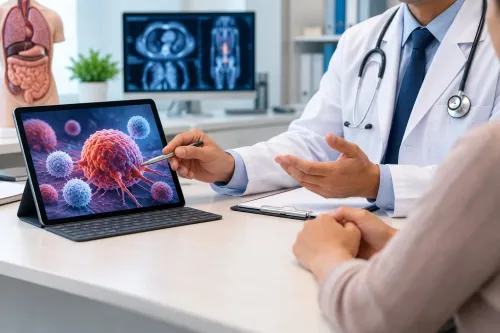

Finding targeted treatment from Badlapur depends on more than locating a clinic that uses the phrase “targeted therapy.” You need to confirm the cancer biomarker, testing pathway, drug supply, administration or prescription process, monitoring arrangements and follow-up location before treatment begins.
Key takeaways
- Confirm the cancer type and biomarker before choosing targeted treatment.
- Ask whether the centre provides drug procurement, infusion and toxicity monitoring.
- Bring pathology slides, biopsy reports, scans and previous treatment records.
- Book a medical-oncology review to match test results with an approved therapy.
Is targeted therapy available in Badlapur or nearby cancer centres?
Targeted therapy near Badlapur is available only when the centre can coordinate the complete treatment pathway, not merely offer an oncology consultation. That pathway includes medical-oncology assessment, pathology review, validated biomarker testing, drug procurement, oral-drug monitoring, intravenous infusion, toxicity management and follow-up.
| Option | What it may provide | What to confirm |
|---|---|---|
| Badlapur clinic or hospital | Consultation, records review and treatment planning | Does it perform the required biomarker test, arrange the medicine and provide infusion or monitoring? |
| Dombivli, Kalyan or Thane centre | Specialist review, molecular testing, infusion and follow-up | Is the drug available on the planned date, and can complications be managed there? |
| Tertiary cancer centre | Complex testing, uncommon medicines and specialist support | Which visits require travel, and which services remain local? |
Care may be arranged in Badlapur itself, or you may need to travel to Dombivli, Kalyan, Thane or another tertiary cancer centre depending on the drug and laboratory facilities. A local appointment does not guarantee local access to every medicine, infusion chair, specialist or molecular test.
Before travelling, ask:
- Does the centre perform the test, or send it to a named laboratory?
- Is the medicine in stock on the planned date?
- Is treatment an outpatient infusion or an oral prescription, and how long is observation?
- Which service handles fever, breathlessness, severe diarrhoea, bleeding or an infusion reaction after hours?
Plan for repeat visits for blood tests, scans, infusions, dose adjustments and follow-up. These journeys can matter as much as the first consultation.
Which cancers and biomarkers can qualify for targeted treatment?
A cancer diagnosis alone is not enough to choose a targeted drug. Eligibility depends on the tumour site, stage, pathology, previous treatment and a predictive biomarker such as HER2, EGFR, ALK, BRAF V600, KRAS, NRAS, BRCA or a hormone receptor.
| Biomarker | Cancer example | Possible treatment decision |
|---|---|---|
| HER2 | Breast cancer | Trastuzumab may be used |
| EGFR | Non-small-cell lung cancer | Osimertinib may be considered |
| ALK | Lung cancer | Alectinib may be considered |
| BRAF V600 | Melanoma | Dabrafenib plus trametinib may be used |
| KRAS or NRAS | Colorectal cancer | Results influence treatment selection |
| BRCA or hormone receptor | Selected breast, ovarian or other cancers | Guides approved treatment options |
Each medicine depends on the cancer type and its approved indication. Targeted cancer treatment badlapur may be used for advanced disease, recurrence or selected earlier-stage settings, alongside surgery, chemotherapy, radiotherapy, hormone therapy or immunotherapy. Oral tablets, injections and intravenous medicines all have different monitoring needs.
A positive biomarker does not guarantee benefit. The alteration must be clinically meaningful for that tumour, and resistance can develop; repeat scans, another biopsy or a different molecular test may then be needed. Ask the oncologist what the result predicts, which treatment evidence supports it and what alternative plan applies if the tumour progresses.
What tests confirm whether targeted therapy is suitable?
A biopsy report alone may not show whether targeted therapy is suitable. You need a biomarker test that identifies a treatment-relevant protein, gene change or pathway in the tumour.
| Test | What it detects | Common use |
|---|---|---|
| Immunohistochemistry | Proteins such as HER2 | Measures protein expression in tumour cells |
| Fluorescence in situ hybridisation | Gene amplification or rearrangement | Confirms changes such as HER2 amplification |
| Polymerase chain reaction | Selected mutations | Tests specific changes such as EGFR or BRAF |
| Next-generation sequencing | Alterations across multiple genes | Searches for several possible treatment targets |
The oncologist may request the original pathology slides or paraffin tissue block for a second review. This matters when the diagnosis is uncommon, the sample is small, the result conflicts with the clinical picture or treatment depends on a borderline biomarker.
A new biopsy may be needed if the tissue is inadequate, the tumour has changed after treatment or resistance is suspected.
A larger genetic panel is not automatically better. The assay must be analytically reliable, the result must apply to your tumour and the alteration must predict benefit from an available treatment.
Ask:
- Which laboratory performed the test, and which method was used?
- Was the sample adequate for testing?
- Is the result predictive of treatment benefit or merely prognostic?
- How does this result change the recommended plan?
A biomarker-positive result does not guarantee response; resistance can develop.
How does targeted therapy differ from chemotherapy, immunotherapy and antibody-drug conjugates?
Targeted therapy is selective, not automatically mild or risk-free. Chemotherapy attacks rapidly dividing cells through less specific mechanisms, while a targeted drug may block a tumour growth signal, inhibit blood-vessel formation or act on a defined molecular alteration.
| Category | Main action | Common forms or feature |
|---|---|---|
| Chemotherapy | Damages rapidly dividing cells | Intravenous infusion, injection or tablets |
| Targeted therapy | Acts on a molecular alteration or tumour pathway | Oral tablets, infusions or injections |
| Immunotherapy | Activates immune responses or removes immune brakes | Infusions or injections; biomarker logic differs by drug |
| Hormone therapy | Blocks hormone production or hormone signalling | Tablets or injections for hormone-sensitive cancers |
| Antibody-drug conjugate | Uses an antibody to recognise a marker and deliver a linked toxic payload | Usually intravenous infusion; selective but distinct from standard targeted therapy |
Some patients need combinations, such as targeted therapy with chemotherapy, radiotherapy, hormone therapy or immunotherapy. Treatment selection depends on the cancer, biomarker, stage, prior treatment and medicine-specific evidence.
Risks vary by drug and include diarrhoea, rash, mouth sores, liver-test abnormalities, high blood pressure, bleeding or clotting, heart dysfunction, lung inflammation and infusion reactions. Report new symptoms promptly; do not stop treatment or self-treat a rash without contacting the treating team.
Tell the oncologist and pharmacist about every prescription and over-the-counter drug, antacid, herbal product, traditional medicine and regular food or drink. These can change absorption or drug metabolism, especially with oral targeted medicines.
How do you book a targeted therapy appointment from Badlapur?
Contact the oncology clinic or hospital through its official phone number, website or appointment desk. State the diagnosis, stage, current treatment and reason for referral, then ask whether a referral is required and whether your first visit is a consultation, pathology review or treatment session.
For a targeted therapy appointment Badlapur, keep these documents ready:
- Biopsy and immunohistochemistry reports
- Imaging reports and scan discs
- Discharge summaries and recent blood-test results
- Medication and allergy lists
- Previous surgery, chemotherapy, radiotherapy or immunotherapy details
- Insurance documents
- Original pathology slides or the paraffin tissue block, when available
Confirm the visit type before travelling.
| Option | Confirm before travel | Why it matters |
|---|---|---|
| Consultation | Oncologist reviews diagnosis and treatment history | No treatment is given that day |
| Pathology review | Slides, block or digital reports are required | Biomarker interpretation can change |
| Treatment session | Drug, prescription, blood tests and observation time | The medicine may not be stocked |
Ask who reviews the pathology, which biomarker test is required, whether the medicine is authorised in India for that indication, and whether it will be available on your date. Confirm who prescribes and monitors it, the after-hours number for fever, breathlessness, severe diarrhoea, bleeding or infusion reactions, and what the estimate includes.
The total cost can include pathology review, molecular testing, scans, medicine, administration, laboratory monitoring, toxicity treatment and travel. The drug price alone is incomplete. Dr Avinash Talele-Best cancer specialist can discuss the testing pathway and follow-up plan, but verify services directly.
A second opinion helps with rare mutations, large panels, costly off-label drugs or treatment outside a clinical trial.
Related service
Targeted Therapy Attacking cancer cells more effectively with drugs, targeted therapy has has been found to be highly effective. View service → |
Frequently asked questions
Is targeted therapy available in Badlapur or nearby cancer centres?
Targeted therapy for cancer Badlapur patients may be available through a local oncology service or a nearby cancer centre. Confirm that the centre can review pathology, arrange validated biomarker testing, procure the medicine, provide infusions when required and monitor side effects.
Which cancers and biomarkers can qualify for targeted treatment?
Eligibility depends on the cancer’s site, stage, histology and biomarker result. Examples include HER2 in breast and stomach cancers, EGFR and ALK in lung cancer, BRAF in melanoma and colorectal cancer, and KRAS, NRAS or MSI status in colorectal cancer. Your oncologist must match each result with the treatment approved for that diagnosis.
What tests confirm whether targeted therapy is suitable?
The work-up can include biopsy review, immunohistochemistry, fluorescence in situ hybridisation, polymerase chain reaction and next-generation sequencing. The correct test depends on the cancer. Ask whether the laboratory is accredited and whether the report identifies the specimen, method, result and interpretation.
How does targeted therapy differ from chemotherapy, immunotherapy and antibody-drug conjugates?
Targeted therapy blocks a specific molecular alteration or pathway. Chemotherapy damages rapidly dividing cells without requiring one specific biomarker. Immunotherapy activates or releases immune responses, while antibody-drug conjugates use an antibody to deliver a cytotoxic drug to cells carrying a target such as HER2. These treatments can be combined when clinically appropriate.
How do you book a targeted therapy appointment from Badlapur?
Request a medical-oncology appointment and send the centre your biopsy report, pathology slides or blocks, biomarker results, scan reports, medication list and prior treatment records. Ask whether the appointment includes pathology review, treatment planning, medicine availability, infusion scheduling and follow-up for toxicity.
Keywords