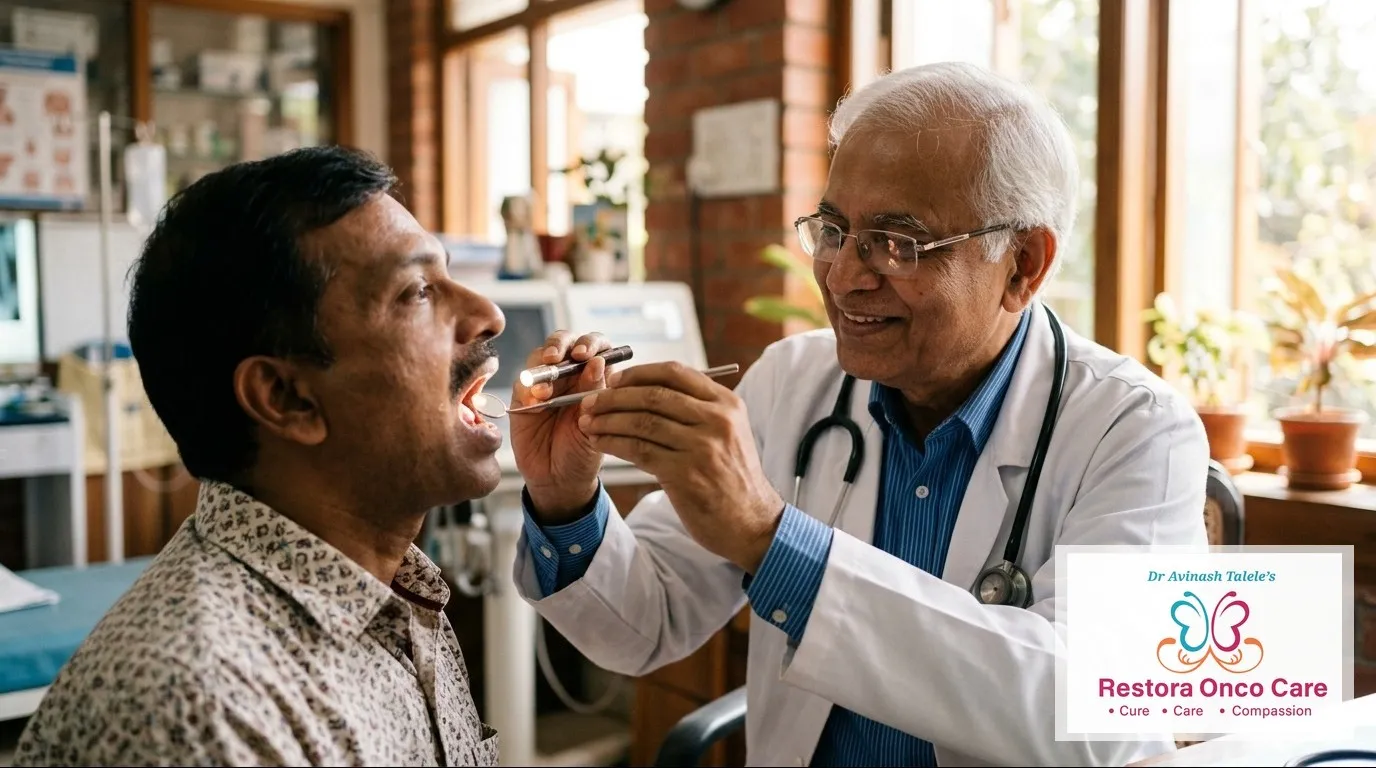
Rajesh noticed a small white patch on his inner cheek three months before he walked into my clinic. He thought it was a stain from paan. His wife thought it was harmless. By the time he came in, that patch had ulcerated, and we were looking at stage 2 oral cancer.
Here's the truth: oral cancer doesn't knock on your door with flashing lights. It whispers. And most people — especially in India, where tobacco use is culturally embedded — mistake those whispers for minor irritations.
I've been treating oncology patients in Mumbai for years, and I can tell you this with certainty: the difference between stage 1 and stage 3 oral cancer isn't just a number. It's the difference between a minimally invasive procedure and a life-altering surgery. The gap between ignoring and noticing can be measured in months, sometimes weeks.
Let me walk you through the early signs of oral cancer that slip past most people's radar — and why you can't afford to ignore them.
### The Silent Progression: Why Oral Cancer Gets Missed
Oral cancer has a deceptive quality. Unlike a broken bone or a high fever, it doesn't scream for attention. The first signs of mouth cancer often masquerade as everyday annoyances: a sore that won't heal, a bit of roughness on your tongue, a persistent ache you chalk up to spicy food.
In India, where gutka, paan, and smoking are prevalent, we see oral cancer rates that are among the highest in the world. According to the Indian Council of Medical Research, oral cancer accounts for nearly 30% of all cancers diagnosed in India. That's not a small number. And yet, most patients present late — when the disease has already progressed beyond the earliest, most treatable stages.
Why? Because they didn't recognize the warning signs of mouth cancer early enough. Or worse, they recognized them and waited.
### 7 Warning Signs of Mouth Cancer You Shouldn't Ignore
#### 1. A Sore or Ulcer That Won't Heal
Most mouth sores heal within 10–14 days. If you've got an ulcer that lingers past three weeks — even if it's painless — that's a red flag. Early-stage oral cancer often presents as a non-healing sore on the tongue, gums, or inner cheek. It might bleed occasionally. It might not hurt at all. That's the trap.
#### 2. White or Red Patches (Leukoplakia and Erythroplakia)
These patches have medical names, but what matters is this: any persistent white (leukoplakia) or red (erythroplakia) patch inside your mouth warrants a biopsy. White patches are more common; red patches are more dangerous. Both are precancerous or cancerous changes in the tissue.
#### 3. Lumps, Thickening, or Rough Spots
Run your tongue along the inside of your cheeks and gums. Feel anything unusual? A lump, a bump, a thickened area that wasn't there before? Don't dismiss it. Oral cancer can present as a firm, painless mass. It grows slowly, which is why people convince themselves it's nothing.
#### 4. Persistent Throat Pain or the Feeling That Something's Stuck
If you've had a sore throat for weeks — no fever, no cold, no obvious infection — and it feels like something's lodged in your throat when you swallow, that's worth investigating. Oropharyngeal cancers often start this way.
#### 5. Numbness or Loss of Sensation
Losing feeling in your tongue, lips, or any part of your mouth is a neurological sign. Cancer can press on nerves, causing numbness or a tingling sensation. If your jaw feels stiff or your tongue doesn't move as freely, don't wait.
#### 6. Chronic Hoarseness or Voice Changes
Your voice has been raspy for over two weeks. You haven't been shouting, you're not sick — but you sound different. Tumors near the vocal cords or throat can alter your voice. It's subtle, but it's significant.
#### 7. Unexplained Bleeding
Bleeding from the mouth without an obvious cause — no injury, no dental work — is a symptom you can't ignore. Even if it's just a spot of blood when you brush your teeth, persistent bleeding needs evaluation.
If you're experiencing any of these oral cancer symptoms you shouldn't ignore, book a consultation immediately. Early detection isn't just important — it's lifesaving.
### What to Do If You Notice These Symptoms
Don't wait. The 'let's see if it goes away' approach costs lives. If a symptom persists beyond two weeks, see a specialist.
Document it. Take photos if possible. Note when it started, whether it's changing, and any associated symptoms.
Avoid self-diagnosis. Only a biopsy can confirm what's happening in your tissue. Guessing is dangerous.
Stop tobacco and alcohol. If you're using gutka, paan, cigarettes, or drinking heavily, stop now. These are the leading risk factors for oral cancer in India.
At Restora Onco Care, we see patients every week who wish they'd come in sooner. The good news? When caught early, oral cancer is highly treatable. Survival rates for stage 1 oral cancer exceed 80%. But that window closes fast.
You can explore advanced cancer care options tailored to your diagnosis, or reach out directly via 💬 WhatsApp +91 84336 80842 for a quick consultation.
### Why Early Detection Changes Everything
I've treated patients whose cancer was caught at stage 1 — a small lesion, a clean excision, minimal reconstruction. I've also treated patients at stage 4 — extensive surgery, radiation, a long road back. The difference? Time. Awareness. Action.
Oral cancer doesn't have to be a death sentence. But it does demand respect. If your body is sending you signals — a sore that lingers, a patch that won't fade, a sensation that feels off — listen.
Don't become another statistic. Read patient reviews on Google to see how early intervention has changed lives, and then take the step that matters: getting checked.
### Take the Next Step — Don't Wait
If any of these warning signs of mouth cancer sound familiar, reach out now. Early-stage oral cancer is beatable. Late-stage oral cancer is a battle.
Connect with Dr. Avinash Talele's Restora Onco Care team today:
📞 Call or WhatsApp: 💬 WhatsApp +91 84336 80842 | 💬 WhatsApp +91 78985 44494
🌐 Visit: dravinashtalele.com
📍 Find us: Restora Onco Care on Google
### Frequently Asked Questions
**Q: What are the very first signs of mouth cancer that I should never ignore?**
A: The very first signs are often subtle: a mouth ulcer that doesn't heal within three weeks, a red or white patch on your gums or tongue, unexplained numbness in your mouth, or a lump in your neck. Many patients dismiss these as minor irritations from spicy food or accidental bites. But if any symptom persists beyond two to three weeks, it warrants an immediate clinical exam. Early detection at stage 1 offers a 90% five-year survival rate, so time truly matters.
**Q: How can I tell if a mouth sore is cancerous or just a regular ulcer?**
A: Regular mouth ulcers heal within 7–10 days, are painful, and usually have a clear trigger like trauma or stress. A cancerous lesion persists beyond three weeks, may be painless initially, has irregular borders, and doesn't respond to standard ulcer treatments. It might bleed easily or feel firm to the touch. The texture and duration are your red flags. If you're unsure, don't wait — get a biopsy.
**Q: Can oral cancer be cured if caught early, and what does treatment look like in Mumbai?**
A: Yes. When diagnosed at stage 1, oral cancer has excellent cure rates — often above 85–90% — with surgery alone or minimal adjuvant therapy. Treatment typically involves surgical excision of the tumour with clear margins, sometimes followed by reconstructive work if needed. In Mumbai, centres like Dr. Avinash Talele's Restora Onco Care offer comprehensive care: diagnosis, surgery, radiation, and rehabilitation under one roof
Here's the truth: oral cancer doesn't knock on your door with flashing lights. It whispers. And most people — especially in India, where tobacco use is culturally embedded — mistake those whispers for minor irritations.
I've been treating oncology patients in Mumbai for years, and I can tell you this with certainty: the difference between stage 1 and stage 3 oral cancer isn't just a number. It's the difference between a minimally invasive procedure and a life-altering surgery. The gap between ignoring and noticing can be measured in months, sometimes weeks.
Let me walk you through the early signs of oral cancer that slip past most people's radar — and why you can't afford to ignore them.
### The Silent Progression: Why Oral Cancer Gets Missed
Oral cancer has a deceptive quality. Unlike a broken bone or a high fever, it doesn't scream for attention. The first signs of mouth cancer often masquerade as everyday annoyances: a sore that won't heal, a bit of roughness on your tongue, a persistent ache you chalk up to spicy food.
In India, where gutka, paan, and smoking are prevalent, we see oral cancer rates that are among the highest in the world. According to the Indian Council of Medical Research, oral cancer accounts for nearly 30% of all cancers diagnosed in India. That's not a small number. And yet, most patients present late — when the disease has already progressed beyond the earliest, most treatable stages.
Why? Because they didn't recognize the warning signs of mouth cancer early enough. Or worse, they recognized them and waited.
### 7 Warning Signs of Mouth Cancer You Shouldn't Ignore
#### 1. A Sore or Ulcer That Won't Heal
Most mouth sores heal within 10–14 days. If you've got an ulcer that lingers past three weeks — even if it's painless — that's a red flag. Early-stage oral cancer often presents as a non-healing sore on the tongue, gums, or inner cheek. It might bleed occasionally. It might not hurt at all. That's the trap.
#### 2. White or Red Patches (Leukoplakia and Erythroplakia)
These patches have medical names, but what matters is this: any persistent white (leukoplakia) or red (erythroplakia) patch inside your mouth warrants a biopsy. White patches are more common; red patches are more dangerous. Both are precancerous or cancerous changes in the tissue.
#### 3. Lumps, Thickening, or Rough Spots
Run your tongue along the inside of your cheeks and gums. Feel anything unusual? A lump, a bump, a thickened area that wasn't there before? Don't dismiss it. Oral cancer can present as a firm, painless mass. It grows slowly, which is why people convince themselves it's nothing.
#### 4. Persistent Throat Pain or the Feeling That Something's Stuck
If you've had a sore throat for weeks — no fever, no cold, no obvious infection — and it feels like something's lodged in your throat when you swallow, that's worth investigating. Oropharyngeal cancers often start this way.
#### 5. Numbness or Loss of Sensation
Losing feeling in your tongue, lips, or any part of your mouth is a neurological sign. Cancer can press on nerves, causing numbness or a tingling sensation. If your jaw feels stiff or your tongue doesn't move as freely, don't wait.
#### 6. Chronic Hoarseness or Voice Changes
Your voice has been raspy for over two weeks. You haven't been shouting, you're not sick — but you sound different. Tumors near the vocal cords or throat can alter your voice. It's subtle, but it's significant.
#### 7. Unexplained Bleeding
Bleeding from the mouth without an obvious cause — no injury, no dental work — is a symptom you can't ignore. Even if it's just a spot of blood when you brush your teeth, persistent bleeding needs evaluation.
If you're experiencing any of these oral cancer symptoms you shouldn't ignore, book a consultation immediately. Early detection isn't just important — it's lifesaving.
### What to Do If You Notice These Symptoms
Don't wait. The 'let's see if it goes away' approach costs lives. If a symptom persists beyond two weeks, see a specialist.
Document it. Take photos if possible. Note when it started, whether it's changing, and any associated symptoms.
Avoid self-diagnosis. Only a biopsy can confirm what's happening in your tissue. Guessing is dangerous.
Stop tobacco and alcohol. If you're using gutka, paan, cigarettes, or drinking heavily, stop now. These are the leading risk factors for oral cancer in India.
At Restora Onco Care, we see patients every week who wish they'd come in sooner. The good news? When caught early, oral cancer is highly treatable. Survival rates for stage 1 oral cancer exceed 80%. But that window closes fast.
You can explore advanced cancer care options tailored to your diagnosis, or reach out directly via 💬 WhatsApp +91 84336 80842 for a quick consultation.
### Why Early Detection Changes Everything
I've treated patients whose cancer was caught at stage 1 — a small lesion, a clean excision, minimal reconstruction. I've also treated patients at stage 4 — extensive surgery, radiation, a long road back. The difference? Time. Awareness. Action.
Oral cancer doesn't have to be a death sentence. But it does demand respect. If your body is sending you signals — a sore that lingers, a patch that won't fade, a sensation that feels off — listen.
Don't become another statistic. Read patient reviews on Google to see how early intervention has changed lives, and then take the step that matters: getting checked.
### Take the Next Step — Don't Wait
If any of these warning signs of mouth cancer sound familiar, reach out now. Early-stage oral cancer is beatable. Late-stage oral cancer is a battle.
Connect with Dr. Avinash Talele's Restora Onco Care team today:
📞 Call or WhatsApp: 💬 WhatsApp +91 84336 80842 | 💬 WhatsApp +91 78985 44494
🌐 Visit: dravinashtalele.com
📍 Find us: Restora Onco Care on Google
### Frequently Asked Questions
**Q: What are the very first signs of mouth cancer that I should never ignore?**
A: The very first signs are often subtle: a mouth ulcer that doesn't heal within three weeks, a red or white patch on your gums or tongue, unexplained numbness in your mouth, or a lump in your neck. Many patients dismiss these as minor irritations from spicy food or accidental bites. But if any symptom persists beyond two to three weeks, it warrants an immediate clinical exam. Early detection at stage 1 offers a 90% five-year survival rate, so time truly matters.
**Q: How can I tell if a mouth sore is cancerous or just a regular ulcer?**
A: Regular mouth ulcers heal within 7–10 days, are painful, and usually have a clear trigger like trauma or stress. A cancerous lesion persists beyond three weeks, may be painless initially, has irregular borders, and doesn't respond to standard ulcer treatments. It might bleed easily or feel firm to the touch. The texture and duration are your red flags. If you're unsure, don't wait — get a biopsy.
**Q: Can oral cancer be cured if caught early, and what does treatment look like in Mumbai?**
A: Yes. When diagnosed at stage 1, oral cancer has excellent cure rates — often above 85–90% — with surgery alone or minimal adjuvant therapy. Treatment typically involves surgical excision of the tumour with clear margins, sometimes followed by reconstructive work if needed. In Mumbai, centres like Dr. Avinash Talele's Restora Onco Care offer comprehensive care: diagnosis, surgery, radiation, and rehabilitation under one roof
Keywords